

When Kafka’s Metamorphosis is discussed, all attention centres on Gregor Samsa. His transformation into an insect is analysed (Kafka wrote Verwandlung, not Metamorphose); his relationship with his family, his guilt, alienation and work are examined, leading ultimately to the question of what human condition all the events of the story might be a metaphor for.
The other protagonist
Yet there is another looming, if apparently innocuous, protagonist: Gregor’s room.
If we look closely at the story, Gregor’s room is not simply a static backdrop against which the story is projected, but a living, meaningful narrative element, a character in its own right whose changes trigger reactions and drive events, determining the very meaning of its occupant.
At the beginning of the story, it is a travelling salesman’s room. Kafka describes it almost bureaucratically, as though it were part of the equipment that makes up the standard human being in salesman configuration. There are the bed, the table, the furniture and the collection of fabric samples. The presence of the samples is particularly significant because it brings work into the space of the personality. The room serves to prepare journeys and organise the goods to be shown, through which the family is supported.
At this stage, the space has an evident human structure, solid and self-evident. The furniture defines routes, functions and habits, and every object presupposes a human body that uses it. The table implies writing. The wardrobe implies clothes to be worn. The bed implies someone’s sleep. The room reflects the idea of a person.
A human room is defined by the function of its objects, because objects gather human intention and conform to it. They make its occupant’s purposes visible and preserve images of whoever lives there.
Indeed, as long as that room remains as it was, Gregor continues to be inscribed within a structure that first defines him, and then remembers him, as a man.
The second transformation
After Gregor’s first transformation, since both Gregor and the room will undergo more than one metamorphosis, it is the room’s turn, and from the moment it first begins to change, it drags a long sequence of events in its wake.
At first, the family continues to treat it as a human room. The furniture remains in place. Its functions remain unchanged, even if no longer performed. The table still implies writing. It is as though the space were resisting the new reality and continuing to safeguard the possibility of a return.
The tension emerges only when the mother and sister discuss whether, out of pity, to remove the furniture. From a practical point of view, the decision seems simple: Gregor climbs the walls and ceiling, and the furniture gets in his way. Clearing the room means increasing his mobility. Obvious.
But symbolically, it is an enormous decision, because removing the furniture ratifies the abandonment of the possibility that Gregor might become a man again. The unused furniture in the room constitutes a reserve of identity that the mother sees more clearly than the sister. This is why she objects: she understands intuitively that removing the furniture means accepting the transformation as final.
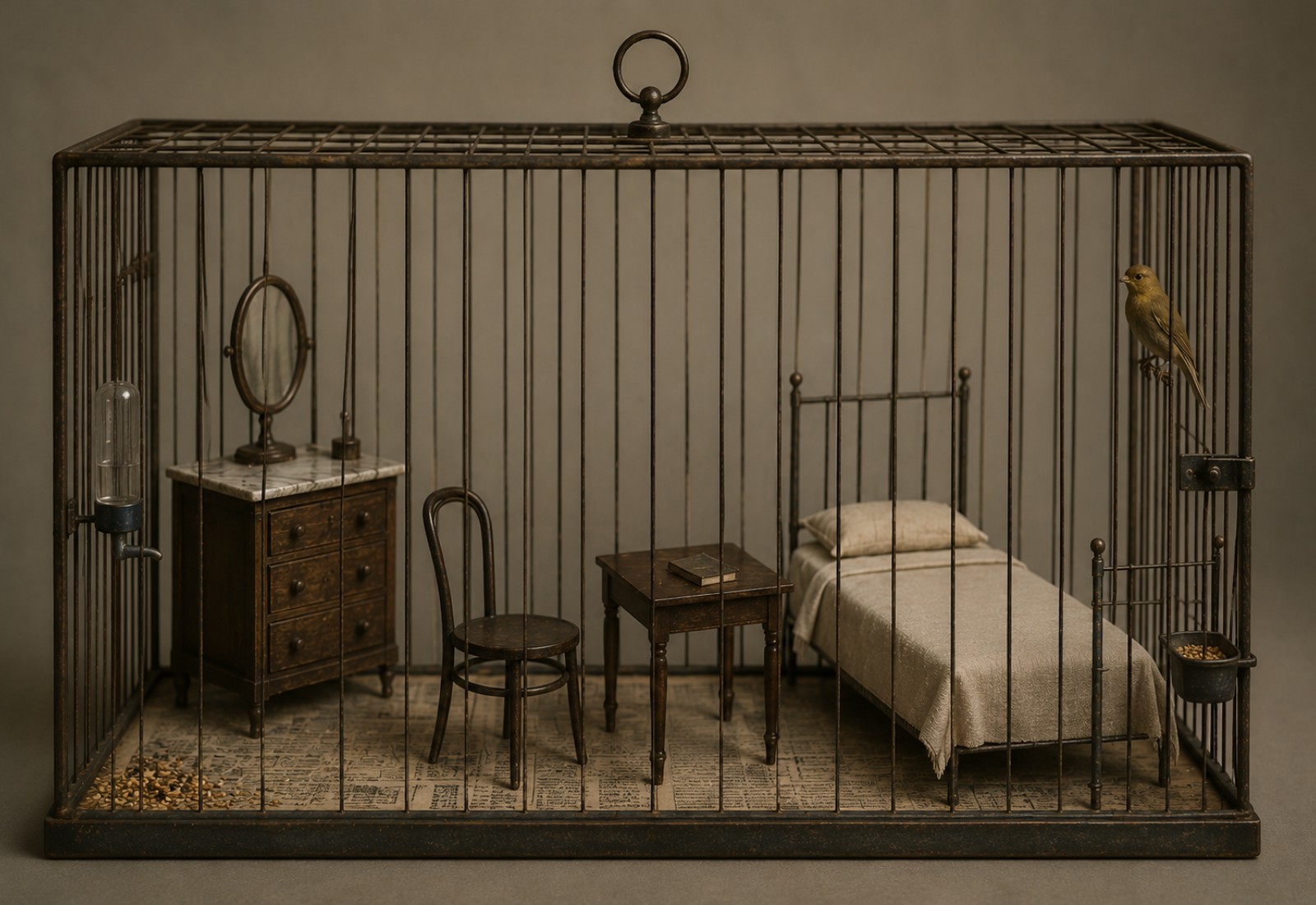
The sister, by contrast, wants to adapt the room to Gregor’s new nature. And this is where the room’s nature truly changes. The furniture is removed, the surfaces are cleared, the empty walls acquire importance, and the space progressively loses the characteristics of a bedroom to acquire those of a cage.
The point of view changes too. In the original room, attention centred on the furniture, whereas in the cage, attention centres on the walls. Because the human being uses objects. Whereas the insect is subject to the perimeter.
A human room is defined by the functions it makes possible. A cage is defined by the limits it imposes. The human being lives in a space organised by purposes. The animal and the insect live in a space organised by constraints. The room makes Gregor definitively legible as an insect. It becomes increasingly difficult to imagine him as anything other than what the room has become a container for. The space has ceased to be built for a person and has become specialised for a giant insect. Gregor’s new identity is confirmed by the environment that contains him.
But the transformation that has turned a room into an enclosure, a cage, does not find its stopping point in that cage.
As time passes, the family gradually stops considering the room even as an inhabited space and begins to use it for storage. They accumulate unused objects, old furniture, discarded materials and things that might be described as having nowhere else to go.
The cage becomes a storeroom
The family has not deliberately created the storeroom. They have produced it through a series of small, apparently practical and reasonable acts. Each thing with nowhere else to go that they have put down in Gregor’s room communicates that this space is unimportant, that it is the space for unimportant things.
The room is no longer a bedroom. It is no longer a cage. It has become the place where things end up that have no place in the house or in the world. And Gregor is dragged into the same classification, defined by it.
At first, he was the family’s main breadwinner. Then he became an embarrassing problem. Then a tolerated presence. Then a forgotten presence, almost as non-existent as all the objects piled up in lumber rooms.
What is striking is the simple fact that the family never explicitly decided to transform the room. No one called a meeting to decree that Gregor should live in a storeroom. It was the sum of small, reasonable actions that transformed what had been, all things considered, a comfortable room into a cage, then into a storage space, and finally into the paradoxical place where things without a place go.
Kafka thus reveals a dynamic that characterises many human realities. Spaces acquire the meaning of the practices carried out within them. A room is defined less fully by what we declare it to be than by what we do inside it.
In this sense, Gregor’s room tells a story almost independent of its occupant. At first, it is a space designed for a worker. Subsequently, it becomes a space designed for an animal. Finally, a space designed for worthless things. Gregor’s trajectory follows the same sequence. First a man. Then an insect. Then an object.
But perhaps it is not Gregor who drags the room down this descent, but rather the room which, as it changes, makes it harder each time to imagine Gregor differently. When the family empties the room, Gregor appears fully realised as a giant insect. When they fill it with junk, Gregor appears as refuse.
Every transformation of the environment makes it harder to imagine a return that will, in fact, never come. Every transformation of the space defines and consolidates a new Gregor from whom there is no going back. Space is the dimension of irreversibility.